

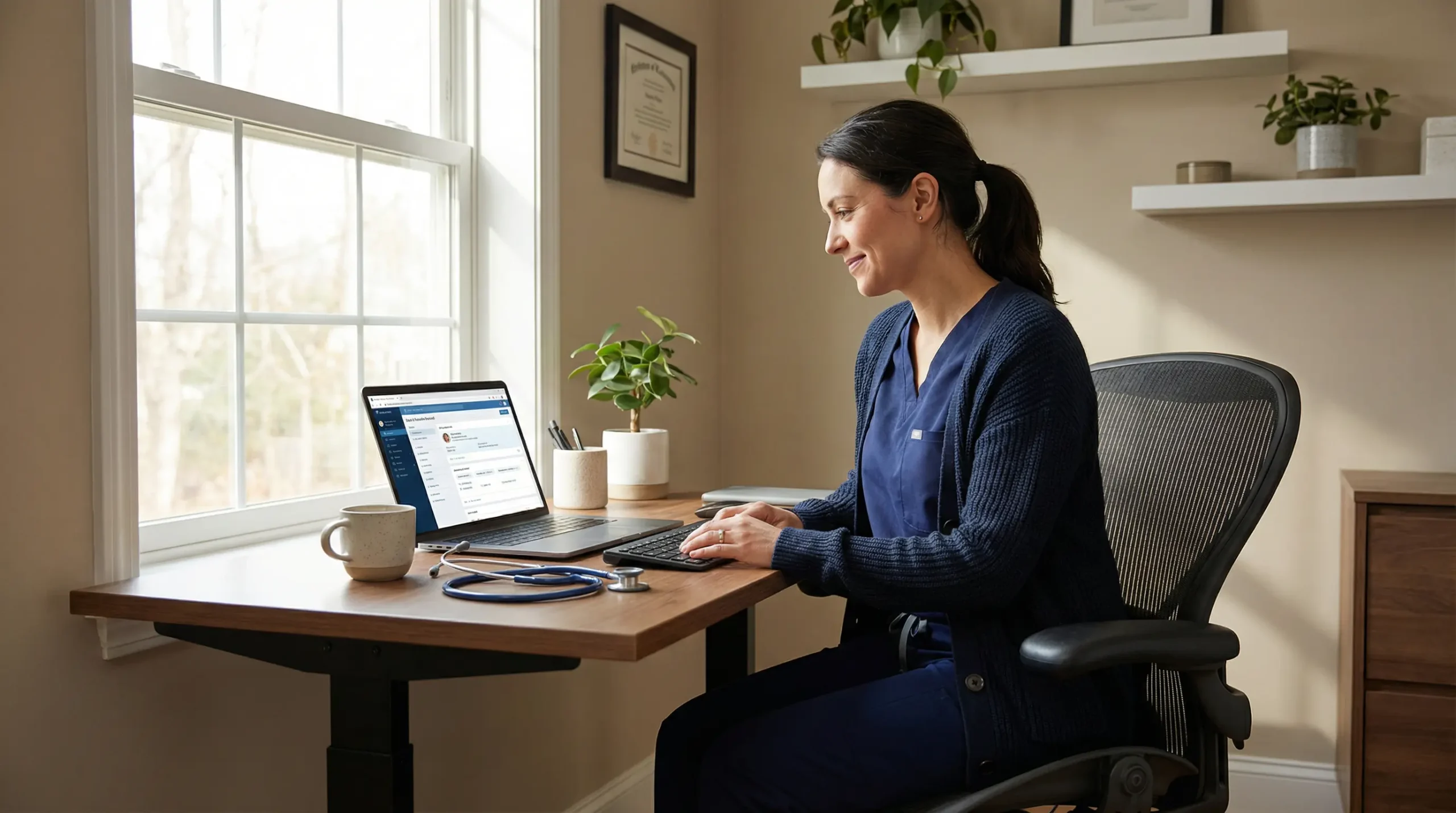
Remote nursing jobs have transformed healthcare delivery, allowing nurses to provide patient care, education, and clinical support without stepping into a traditional hospital setting. The shift to telehealth has created diverse opportunities for remote nursing professionals seeking flexibility and work-life balance. Remote US licensed RNs can now choose from roles like telehealth nurses, case managers, triage nurses, and clinical educators.
In this guide, we’ll walk you through what remote nursing involves, the requirements to get started, top job opportunities in 2026, and strategies to find and succeed in virtual nursing positions.
What Is Remote Nursing and Why Is It Growing in 2026
The shift to telehealth and virtual care
Virtual care has evolved from a pandemic necessity to a cornerstone of modern healthcare delivery. Before 2020, fewer than 1% of patient visits were conducted online. During the early pandemic, virtual appointments jumped to nearly 50% of all outpatient encounters. While usage has stabilized at 13-17%, this still represents a dramatic and permanent shift in how healthcare is delivered.
The financial investment reflects this transformation. U.S. virtual care revenue is expected to reach $100 billion by 2025, with up to $250 billion in current healthcare spending considered virtualizable. These projections signal sustained confidence in remote nursing as a viable care delivery model.
Virtual nursing now encompasses remote patient monitoring, chronic disease management, post-discharge follow-up, and teletriage services. The concept extends beyond simple video consultations. By mid-2023, 330 hospitals held CMS waivers allowing acute patients to receive care at home while nurses monitor them remotely. Mayo Clinic and Kaiser Permanente invested $100 million to scale Medically Home, an at-home acute care company, after seeing lower readmission rates.
Key statistics and trends driving remote nursing
Patient acceptance drives market growth. 94% of patients who had a virtual health visit were willing to have another, a significant increase from 80% in 2020. This acceptance rate creates sustained demand for remote US licensed RNs across multiple specialties.
Value-based care models fuel adoption. 65% of chief nursing officers cited value-based care as a primary catalyst for telehealth adoption. Consequently, healthcare organizations prioritize remote nursing roles that improve outcomes while reducing costs.
The cost-effectiveness proves compelling. The average emergency room visit costs $1,734, while the average doctor’s visit runs $149. In contrast, the average telehealth visit costs $79. Remote patient monitoring reduces hospitalizations, hospital readmissions, and length of stay.
Patient satisfaction remains high. 77% of individuals who tried virtual visits report a high level of satisfaction, with consumers managing chronic conditions reporting even higher satisfaction rates. Healthcare providers share this sentiment: 64% report they are now more comfortable using telehealth technology.
Industries and healthcare settings hiring remote nurses
Remote nursing jobs span diverse healthcare environments. Hospitals and large health systems integrate telehealth nurses into chronic disease management and post-acute care teams. Insurance companies employ remote nurses for case management and utilization review.
Additional employment opportunities include:
- Outpatient clinics and home health agencies extending their reach through virtual services
- Call centers and remote nursing service providers offering around-the-clock triage
- Public health organizations utilizing telehealth for underserved populations
- Private companies and start-ups launching direct-to-consumer telehealth services
Many positions allow nurses to work from home, offering improved work-life balance and reduced burnout compared to traditional bedside nursing. The 2024 adoption trajectory shows the first year that a majority of U.S. hospitals and health systems surveyed have a virtual nursing program in place. This expansion creates opportunities for nurses seeking flexible schedules and the ability to serve patients across wide geographic areas.
Requirements to Start Working as a Remote Nurse
Nursing licenses and multi-state compact requirements
Starting remote nursing work requires an active RN license at minimum, earned after completing the NCLEX-RN. An Associate Degree in Nursing meets baseline requirements, though employers increasingly prefer or require a BSN. Most positions also expect at least two years of bedside experience, with backgrounds in triage, case management, emergency, or acute care particularly valued.
Licensure becomes more complex for remote US licensed RNs because the patient’s location determines which state license you need. The Nurse Licensure Compact (NLC) addresses this challenge. As of 2026, 43 jurisdictions participate in the NLC. A multistate license issued by your primary state of residence allows you to practice across all compact states. If you hold a multistate compact license and provide telehealth services, you can treat patients in other compact states without additional licensure. However, treating a patient in a non-compact state like California, New York, or Illinois requires obtaining a single state license for that specific state.
Essential certifications for remote nursing roles
Most entry-level remote nursing jobs don’t require specialized certifications. Remote nursing represents a workplace setting rather than a distinct specialty. The Ambulatory Care Nursing Certification (RN-BC) from the American Nurses Credentialing Center strengthens applications, as telehealth nursing falls within ambulatory care nursing. This certification contains enhanced telehealth content and serves as the gold standard credential for nurses providing care to patients in ambulatory settings like their homes.
Additional certifications depend on your target role. Case management positions may benefit from Certified Case Manager (CCM) or Nurse Case Manager Certification (CMGT-BC) credentials. Informatics roles value RN-BC Informatics certification. Specialty certifications like OCN for oncology roles or CDCES for diabetic educator positions at medical device companies add value when aligned with specific job requirements.
Technical skills and digital proficiency needed
Remote nursing runs on technology, making digital proficiency non-negotiable. You need comfort with EHR systems like Epic and Cerner, video conferencing platforms, remote monitoring tools, and secure messaging. The ability to troubleshoot basic technical problems independently matters, as does familiarity with computer hardware components such as monitors and routers.
Clear communication skills become even more critical in remote settings. Without hands-on exams to fill information gaps, your speaking and active listening abilities carry more weight. Written communication must be equally strong for documenting patient encounters and collaborating with healthcare teams.
HIPAA compliance and regulatory knowledge
Understanding HIPAA requirements ranks among the most essential competencies for remote nursing jobs. The Health Insurance Portability and Accountability Act establishes specific rules for handling patient information, and these rules apply whether you work in a hospital or your home office. You must work in a secure environment, use protected servers, and maintain patient confidentiality at all times.
HIPAA compliance at home means using only approved, encrypted telehealth platforms. Strong, unique passwords combined with two-factor authentication protect patient data. Regular software updates patch security vulnerabilities. You should lock your screen during breaks and avoid saving patient information to personal cloud storage unless explicitly approved by your employer.
Required equipment and home office setup
Most companies provide core technology equipment. Before purchasing anything, check with your recruiter or HR team to confirm what the employer supplies and whether you can connect personal equipment to company systems. Some organizations offer office setup stipends, though this varies by company.
You need a dedicated workspace with good lighting, ergonomic furniture supporting your back, and a desk spacious enough for your daily equipment. A quiet, private space for patient calls maintains confidentiality. Starting with basics that support comfort and focus makes more sense than buying everything at once.
Top Remote Nursing Job Opportunities in 2026
The remote nursing landscape offers diverse career paths, each requiring different skill sets and clinical backgrounds. Understanding these opportunities helps you identify which roles align with your experience and career goals.
Telehealth nurse
Telehealth nurses serve as the first line of communication for patients seeking remote care. They assess patient needs through video conferencing or phone calls, determine appropriate next steps, and provide instructions for in-person or emergency care when needed. These nurses perform virtual assessments, patient monitoring using wearable devices, and extensive documentation. Employers typically prefer candidates with at least a few years of bedside experience. The average annual salary for RNs in telehealth positions runs around $93,307, while LPNs earn approximately $59,254 per year.
Remote case manager
Remote case managers coordinate care for patients with complex or chronic health conditions. They work extensively over the phone, providing patient education, connecting individuals to resources, and managing transitions between care settings. Most positions require 3-5 years of bedside nursing experience. Case managers employed by insurance companies like United Healthcare, Cigna, or Blue Cross Blue Shield focus on helping patients access affordable medications and support services. Average salaries range from $70,000 to $90,000 annually.
Remote triage nurse
Unlike emergency room triage nurses, telephone triage nurses assess patient needs remotely before referring them to appropriate in-person care. They conduct live video conferences, create educational resources, and manage mobile health applications. These positions require at least 2,000 hours of clinical nursing experience. The average salary sits at $81,105, with projected job growth of 6% between 2022 and 2032.
Utilization review nurse
Utilization review nurses evaluate medical necessity and appropriateness of care for insurance companies or healthcare facilities. Remote roles in this specialty typically pay between $28 and $46 per hour.
Remote nurse educator
Nurse educators develop training programs, teach continuing education courses, and mentor nursing staff remotely. Hourly rates range from $75 to $110 for remote positions.
Legal nurse consultant
Legal nurse consultants review medical records for law firms, insurance companies, or healthcare organizations. They analyze cases, identify standards of care issues, and provide expert opinions. Remote positions in this field offer salaries between $68,000 and $142,000 annually.
Clinical research coordinator
Clinical research coordinators support clinical trials by recruiting participants, collecting data, and ensuring protocol compliance. Remote opportunities exist with pharmaceutical companies and research organizations.
Medical writer and clinical documentation specialist
Clinical documentation integrity specialists review medical records to ensure accurate coding and complete documentation. This role requires strong analytical skills and knowledge of medical coding. Notably, 53% of RN respondents in CDI roles reported earning over $110,000 per year.
How to Find and Land Remote Nursing Positions
Where to search for remote nursing jobs
Job boards specifically designed for remote US licensed RNs yield better results than general employment sites. Indeed lists over 1,444 virtual telehealth nurse job openings. Nurse Fern offers free resources including a downloadable remote nursing transition guide and a database of remote nurse job titles with company names. The Telehealth Nurse Network Job Board filters for remote roles and identifies actively hiring companies. Remote Nurse Connection provides a premium membership with exclusive access to vetted opportunities five days before they appear on free boards.
Major employers hiring remote nurses include insurance companies, staffing agencies, hospitals, major corporations, triage contractors, researchers, public health departments, and consulting firms. Companies like Teladoc, UnitedHealth Group, and Wheel Health frequently post openings on LinkedIn and specialized nursing platforms.
Building a resume for virtual nursing roles
Your resume needs to clearly demonstrate how your clinical background translates to virtual care. Include contact information, a professional summary highlighting relevant experience, detailed work history in reverse-chronological format, skills section, education, and certifications. Write five bullet points for your most recent position and three for others, quantifying responsibilities when possible.
Remote employers look for specific keywords: telehealth nurse, remote patient monitoring, care coordination, clinical triage, virtual patient assessment, HIPAA compliance, remote charting, EHR/EMR systems like Epic or Cerner, patient education via phone or video, chronic disease management, case management, telephonic triage, and care plan development. Tailor your resume to each job description by identifying repeating skills and certifications mentioned across multiple postings, then incorporating those exact terms.
The Telehealth Nurse Network AI Resume Builder creates tailored resumes by analyzing your experience alongside target job descriptions, delivering completed resumes within 1-2 hours. This tool helps position bedside experience for virtual roles without guesswork.
Preparing for remote nursing interviews
Virtual interviews require technical preparation beyond clinical knowledge. Test your internet connection, camera, and microphone beforehand. Choose a quiet, well-lit space for the video call. Research the company’s telehealth platforms and patient population.
Networking strategies for telehealth opportunities
Professional connections often determine who gets interviews versus whose applications disappear. Join the Telehealth Nurse Network Community on Facebook for remote job leads and advice. LinkedIn serves as a primary platform where recruiters search for candidates, so join remote and telehealth nursing groups, follow target employers, and comment on relevant posts.
Professional nursing associations provide networking opportunities at local and national levels. State organizations keep members updated on legislation and education practices. Attending conferences puts you in contact with nurses further along your desired career path. One nurse landed a role with Wheel Health after commenting on a telehealth workflow thread, while another received a mock interview offer through liking a case management post.
Making Remote Nursing Work: Benefits, Challenges, and Best Practices
Key advantages of working from home as a nurse
Remote nursing jobs eliminate commuting stress while offering schedule flexibility that bedside work cannot match. Salary parity exists, with positions ranging from $70,000 to $95,000 annually. The work reduces physical demands on your body, allowing nurses recovering from injuries or managing chronic conditions to continue clinical practice. Burnout affects 6 in 10 nurses, and remote roles address several root causes by removing exposure to acute trauma and workplace violence.
Common challenges and how to overcome them
Isolation from colleagues ranks as the top barrier, with nurses reporting disconnection from organizational culture and loss of personal relationships. Create a separate workspace you avoid outside work hours to combat blurred boundaries between home and professional life. Technological barriers require reliable internet and familiarity with platforms. Productivity tracking replaces traditional oversight, measuring calls per hour or average handle time.
Time management and productivity tips
Prioritize patient assessments and time-sensitive treatments before lower-urgency tasks. Avoid multitasking, as dividing attention drains cognitive resources and increases error risk. Take designated breaks even when busy, maintaining mental stamina throughout your shift.
Maintaining work-life balance in remote nursing
Work-life balance requires intentional boundaries rather than automatic separation. Establish morning routines and disconnection rituals, like logging out mindfully or exercising after shifts. Prepare tomorrow’s tasks before ending each day, preventing mental energy drain during evening hours. Barriers often stem from ingrained trauma responses affecting self-worth, requiring patience and potentially therapy support to overcome.
Conclusion
Remote nursing offers a legitimate career path with competitive salaries and meaningful patient impact. The opportunities span telehealth, case management, triage, and clinical education roles, each requiring different experience levels and certifications. Obviously, transitioning from bedside to virtual care takes preparation, from obtaining multistate licensure to mastering digital platforms and HIPAA compliance.
The benefits are clear: flexibility, reduced physical strain, and better work-life balance. Challenges like isolation and productivity tracking exist, but strategies outlined here address them effectively. Start by identifying which remote role matches your clinical background, then use specialized job boards like Nurse Fern and the Telehealth Nurse Network to find opportunities. Your bedside experience translates directly to virtual care, provided that you position it correctly and build the right connections.
